
Virtual school, real connections: How Arizona’s online students are finding community and thriving
Jul 24, 2026
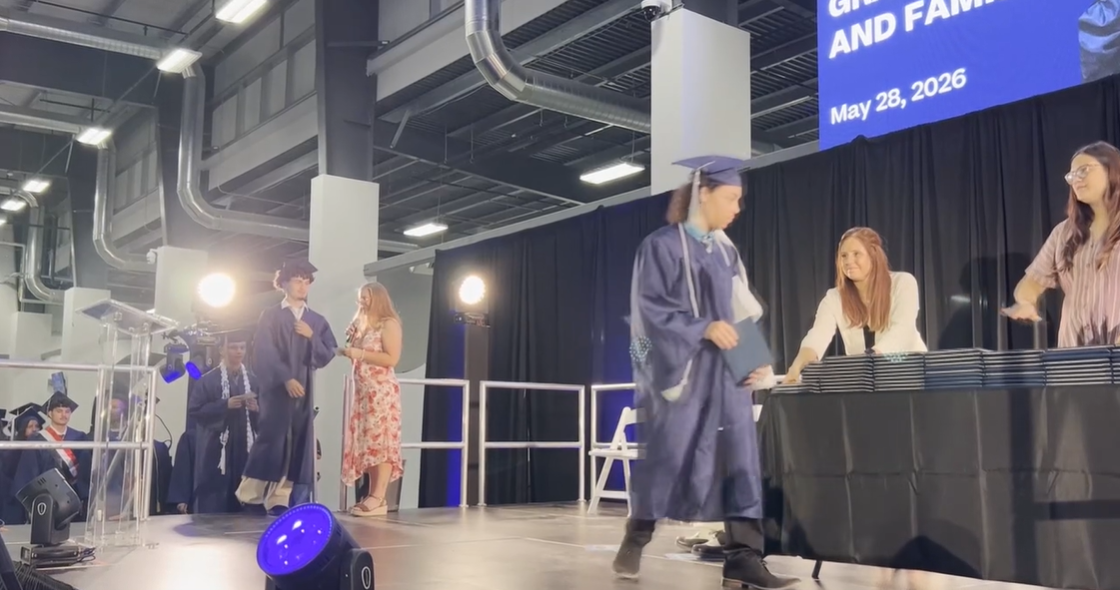
Students say closer friendships, not isolation, shaped their online learning experience. The proof is when many met in person for the first time at graduation.
TEMPE, Ariz. — When Arizona Virtual Academy valedictorian Victoria Shaffer walked into graduation last month, she made a beeline for one of her closest friends, someone she’d known for three or four years, laughed with, leaned on and studied alongside.
It was the first time they had ever met in person.
“I saw her and I immediately just walked right up to her and gave her a hug,” Shaffer said.
That moment, years in the making, captures something that surprises even the people who run Arizona’s largest online schools.
Arizona Virtual Academy and Insight Academy of Arizona together serve nearly 7,000 families across the state. Students log in from Sierra Vista, from farms in southern Arizona, from the forests and mountains of the north. Many have never shared a classroom, or even a zip code, with their classmates.
And yet, by graduation, most of them know each other well.
“The most surprising thing that we see is how well they actually do know each other,” said Forrest Smith, executive director of both schools. “They know each other just the same way that you would in a brick-and-mortar campus. They just interact the way you’d interact over a video call.”
This spring, about 600 students graduated across the two schools. Roughly 200 attended each ceremony. Smith estimates at least half of those students, Shaffer included, recognized and embraced each other on the spot.
Some had been together since third grade.
Two weeks before graduation, nearly 300 students gathered for the school’s fifth annual prom at the Arizona Athletic Grounds in Mesa. The theme: “A Night on the Hollywood Red Carpet.” Admission was free.
A DJ. A dance floor. A scavenger hunt to break the ice. A QR code to cast your vote for prom king and queen.
Within 45 minutes, according to Smith, the dance floor was full.
The prom, like graduation, is organized each year by the students themselves. Shaffer served as student body president her junior year and helped plan both events, one of many ways, she said, that AVA gives students ownership over their own experience.
“We can kind of be our own people and create our own things,” she said.
The assumption that online students are isolated or missing out doesn’t match what Smith sees at graduation each year.
What he sees instead is a cross-section of students whose needs weren’t being met in a traditional setting, and who found something that worked.
Some came to escape bullying or unsafe campuses. Shaffer said her nearest traditional option, a high school in Sierra Vista, had experienced lockdowns. The next closest school was so overcrowded, she’d heard, that students couldn’t move through the hallways between classes.
Some came for flexibility. Shaffer mentioned classmates who run farms with their families, who couldn’t choose between their animals and their education, and no longer have to.
“They go to school, have class, go check on the animals, go to class, check on the animals,” she said. “It’s a much better environment that way.”
And some, like a young man Smith met in person at graduation this year while helping him tie his tie, found that the flexibility of virtual school unlocked something entirely unexpected.
“He said, ‘This school thing has let me become an HVAC tech,'” Smith recalled. “He’d gotten certified and had been working for three months. He said, ‘I have a job, I’m making good money.’ The fact he didn’t do that with any prompting from us… if you have that motivation, this can really take you to new heights.”
For Shaffer, one of the most unexpected gifts of virtual school was the geography of her friendships.
Her best friend lives three hours north of her. Another friend lives five hours away. Another six.
“You don’t get to form these bonds in in-person school because the people you’re with live in the same city or the neighboring city,” she said. “But we live all over the state, and we get to learn more about Arizona because of it. My best friend lives in the forest and mountains. I live in the desert. It’s incredible to see just the difference that a couple of hours can make.”
Those friendships, built over years of shared live classes, private messages, and two- and three-hour study sessions in virtual “help labs,” feel as real to her as any formed across a cafeteria table.
Maybe more so.
“I think that this form of connection is even better,” she said.
Shaffer gave the valedictorian address at graduation. Her topic: legacy, and how each person can impact the world with theirs.
She’s already thinking about hers.
“I’m hoping to be one of the first people on Mars,” she said, “and build habitats for us to live on.”
She’ll study aerospace engineering at ASU this fall, joining ROTC and a program called the Grand Challenge Scholars Program. She’ll be on campus, in person, for the first time.
After four years of thriving online, she’s ready.
This story is made possible through grant funding from the Arizona Local News Foundation’s Arizona Community Collaborative Fund.